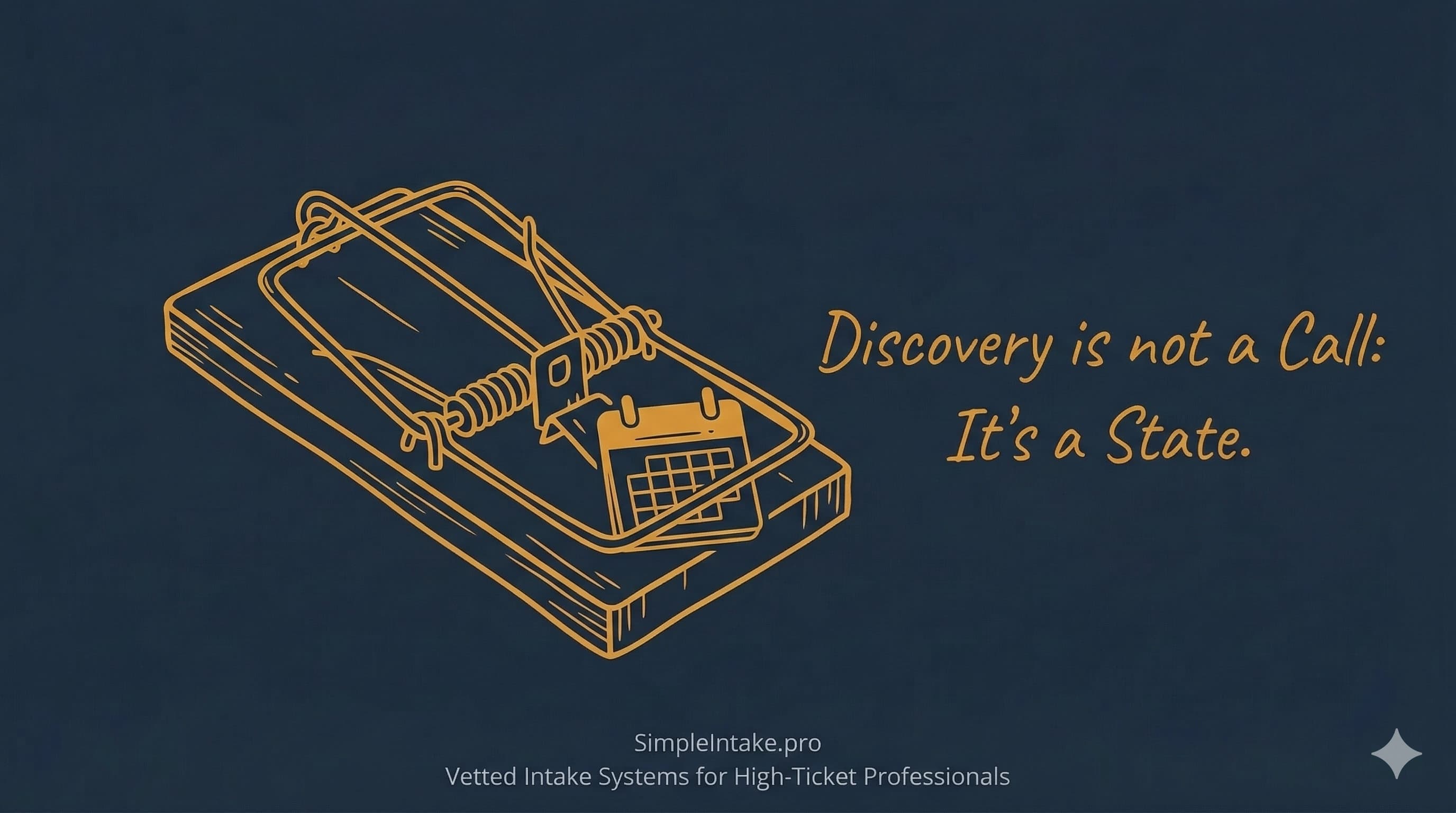
Discovery Is Not a Call. It's a State.
How High-Ticket Professionals Are Losing Clients Before the Conversation Ever Begins
The Word Has Been Stolen
Somewhere along the way, the consulting industry stole a word and redefined it badly.
Discovery. It used to mean something true and directional — the moment a client finds you, understands what you do, decides you are worth pursuing. It was always about them finding you. It was always a state of being found.
Then the industry turned it into a calendar event.
The "discovery call" — that 45-minute open invitation extended to anyone with a link and a curiosity — became the default entry point for high-ticket practices everywhere. Coaches, fractional executives, therapists, consultants. All of them booking calls with strangers, hoping the conversation would do the qualifying work that should have happened long before the invite was sent.
The word got inverted. Discovery became something the professional does — a call they run, a script they follow, a pitch they deliver. And in that inversion, the entire economics of a high-ticket practice began to quietly bleed.
This piece is about taking the word back.
Discovery is not a call. It is a state — the ongoing condition of being findable, citable, and authoritative in the channels where your ideal clients are already looking. Everything else is downstream. The call, the intake, the proposal — none of it matters if the discovery state is broken.
And for most high-ticket professionals, it is broken. Quietly, expensively, invisibly broken.
Part One: Where Discovery Actually Happens
To understand where discovery goes wrong, you have to first understand where it actually happens.
The popular answer is referrals. And referrals are not wrong — they remain the highest-converting lead source in professional services, with conversion rates on referred calls sitting at 25.56% compared to a cold outreach baseline of 9.38%. For many practitioners, referrals account for 60% to 95% of total business volume.
But here is what the referral-dependent consultant does not see coming.
Referrals as a primary acquisition channel are a generational cliff. 60% of buyers over 60 still hire based on a referral. For buyers under 44, that number collapses to 17%.
The generation currently accumulating wealth, building companies, and hiring high-ticket consultants does not behave the way clients used to. They do not call someone because a friend said so. They use the referral as a trigger — and then they go research. They open LinkedIn. They ask Perplexity. They type a query into ChatGPT. They read, compare, verify. Only after that invisible journey is complete do they decide whether to reach out.
High-ticket buyers consult an average of 10 digital sources and navigate 27 distinct touchpoints before they make first contact with a service provider.
This is where discovery actually happens — in that silent, invisible research phase. Not on your calendar. Not on a Zoom call. In the dark, before you ever know they exist.
The industry term for it is the "dark funnel." It is the 70% of the buying journey that happens before a prospect identifies themselves. And it is the territory that most high-ticket professionals have completely abandoned.
The Channels of the Dark Funnel
So what does the modern buyer actually use to find a consultant in 2026?
Referrals still start the journey, but as established, they trigger research rather than close it. The referral gets you considered. What your digital presence does next determines whether you make it to the shortlist.
LinkedIn is the institutional layer where that verification happens. It is not just a social platform — for B2B buyers it functions as a search engine, a credibility signal, and a trust-building environment simultaneously.
LinkedIn is 277% more effective at generating leads than Facebook and Twitter combined. It drives 80% of all B2B social media leads. For high-ticket professional services, it is not optional infrastructure — it is the primary professional verification layer.
Generative AI is the newest and fastest-growing discovery channel — and the one most consultants have not yet reckoned with.
80% of high-ticket B2B decision-makers now use tools like ChatGPT, Perplexity, and Claude for vendor research at a frequency equal to or greater than traditional search engines. Gartner projects that traditional search engine volume will decline 25% by 2026 as users migrate to AI-curated, answer-based interfaces.
When a founder types "who are the best fractional CFOs for SaaS fundraising" into Perplexity, they are not getting a list of links. They are getting a curated answer. A recommendation. A shortlist. And here is the brutal economics of that moment:
94% of buying groups rank their vendor shortlist in order of preference before they ever initiate contact. The vendor ranked first on a buyer's initial list wins the deal 80% of the time.
If you are not on that list — if the AI cannot find you, cite you, or summarize your expertise coherently — you do not lose the deal. You were never in it.
Google search has also evolved in ways that reward specialists and punish generalists. Buyers are no longer searching for roles. They are searching for solutions to specific problems.
Searches for "fractional CFO for SaaS" have surged 103% year-over-year. Interim CFO requests have grown 310% since 2020. Long-tail, problem-aware queries now account for 70% of all searches.
The consultant who has positioned themselves as a "generalist business advisor" is invisible to a founder searching for "SaaS fractional CFO for MRR optimization." Specificity is discoverability.
Part Two: Where Discovery Goes Wrong
Now that we understand where discovery happens, we can diagnose precisely where it fails for most high-ticket professionals. And it fails in three specific, structural ways.
Take Back Control of Who Gets Access to You
Your calendar shouldn’t be open to everyone. We design a controlled intake layer that filters, qualifies, and prepares every client before they ever reach you. No noise. Just signal.
Failure One: No Canonical Home
The most common and most expensive discovery failure is also the most invisible: there is no single, authoritative place that defines who you are, what you do, and how to engage you.
For most consultants, their identity is scattered. A LinkedIn profile that says one thing. A website that says something slightly different. A Calendly link floating in email signatures. A Medium article from 2022. Maybe a mention on a podcast website. All of it pointing in slightly different directions, using slightly different language, conveying slightly different positioning.
To a human researcher, this looks like inconsistency. It erodes trust without them being able to name why.
To an AI research tool, it is worse. It is noise.
Without a canonical URL — a single source of truth that defines scope, pricing philosophy, and intake procedure — AI tools return incorrect or vague information about a professional in 60% of cases. Inconsistent digital presence means the AI cannot cite you confidently. It may hallucinate details or skip you entirely.
This is what "source laundering" looks like from the machine's perspective. Perplexity and ChatGPT are building answers from the most coherent, consistently structured sources they can find. If your information is scattered and contradictory, you are not a reliable source. You get passed over in favor of someone whose positioning is clear, consistent, and structured for ingestion.
70% of consultants receive zero leads from their own websites. Not because no one visits — but because the site is built as a static brochure rather than an authoritative intake destination.
A brochure announces. An authority node converts. The difference is structure, consistency, and a single clear action for the visitor to take.
Failure Two: The Referral Verification Gap
Even when a warm referral lands, the discovery failure can still happen — in the gap between the referral and the outreach.
The modern buyer receives a referral and immediately enters the verification loop. They search your name. They find your LinkedIn. They look for your website. They may even ask an AI tool what you are known for.
If what they find does not match the promise the referrer made, the lead evaporates. Not with a no. Just with silence. They move on to the next name on the list.
86% of B2B purchases stall during the research phase, often because buyers encounter misaligned information that erodes trust before they ever make contact.
The referral did its job. The discovery infrastructure failed to do its job. The consultant never knew the lead existed — or that they lost it.
Failure Three: The Open Calendar as a Discovery Signal
The third failure is the one that feels most like a solution. The open calendar. The "book a free discovery call" link. The Calendly embedded in the email signature.
From the practitioner's perspective, this looks like accessibility. I am easy to reach. I am open to conversations. I am not gatekeeping my time.
From the high-ticket buyer's perspective, it looks like something else entirely.
92% of high-ticket buyers start the engagement process with a preferred vendor already in mind. Any friction or misalignment they encounter in the booking process leads to immediate attrition.
But here is the subtler problem. The open calendar does not just invite the wrong prospects — it signals availability in a way that undermines premium positioning. A consultant whose calendar is freely accessible to anyone with a link communicates, unconsciously, that their time is not scarce.
No-show rates for open-calendar discovery bookings average between 19% and 23.5% across professional services — and reach as high as 40% in high-demand niches. Each no-show represents approximately $200 in lost billable capacity. For an active practice, this compounds to $150,000 or more in annual revenue loss.
And the no-show is only part of the story. The prospect who does show up — who was never qualified, never screened, never asked to demonstrate commitment — is the prospect who gets a free 45-minute consulting session and then disappears to "think about it."
The open calendar does not just waste time. It actively trains the market to expect free access to expertise.
Part Three: The Real Cost of Broken Discovery
Let us be precise about what this costs, because it is easy to feel the pain of a bad discovery process without calculating its actual price.
For a consultant billing at $300 to $500 per hour, the math of broken discovery is not abstract.
Sales reps and independent consultants waste up to 50% of their time on unqualified prospects. For a practitioner who should be billing $175 to $325 per hour, spending 10 hours a week on unqualified calls represents a monthly loss of $7,000 to $13,000 in billable capacity.
Beyond the time cost, there is the advice drain — the structural revenue leakage that happens when expertise is given away during the sales process.
Across B2B professional services, unbilled discovery and advice given during intake calls accounts for 4% to 10% of EBITDA. In a practice billing $500,000 annually, that is $20,000 to $50,000 walking out the door in free consultations.
And beneath both of these, there is the cost that cannot be easily tallied: the cost of AI invisibility.
As 25% of search volume shifts to AI tools by 2026, professionals who are not structured for AI discovery are excluded from the shortlist before the buyer even begins their outreach. Since 95% of the time the winner is already on the buyer's Day One list, invisibility to AI search is not a marketing problem. It is an existential pipeline problem.
The fractional CFO who has 14 discovery calls in a month and converts three of them is not running a discovery process. They are running a free advice clinic with a 21% billing rate.
Part Four: What Good Discovery Actually Looks Like
The professionals who have solved this are not doing more. They are doing less, more deliberately.
They have stopped thinking about discovery as an activity — something they perform on a call — and started engineering it as a state. The state of being findable, citable, consistent, and authoritative across every channel where their ideal clients are looking.
Here is what that infrastructure looks like.
One Canonical URL
The foundation of good discovery is structural simplicity: one URL that serves as the definitive, authoritative home of the practice.
Not a LinkedIn profile. Not a Linktree. Not a Calendly page. A dedicated, structured intake destination that tells the right story to both human visitors and AI research tools — consistently, every time, from every source.
This URL does several things at once. For the human visitor, it signals that the practitioner operates with precision. The page is curated, not cluttered. It answers the three questions a high-ticket buyer is always asking: Can this person solve my specific problem? Do they work with people like me? What is the first step?
For AI research tools, it provides what the machines need to cite you confidently: structured, consistent, unambiguous information. Clear headings. A defined scope of work. A specific type of client named. A single action to take.
Sites that provide structured, citable content see disproportionate AI visibility. When Perplexity or ChatGPT surfaces a professional as an authority, it is because their digital home provides clear, parseable, consistent information. One canonical URL eliminates source laundering — the AI uses your own words rather than fragmented third-party data.
Every referral gets sent there. Every LinkedIn DM gets that link. Every podcast bio, every email signature, every conference introduction — one URL. No exceptions.
The Form as the First Qualification Layer
Behind that URL is a gate. Not a wall — a filter.
The intake form is not an administrative formality. It is a qualification instrument — the first moment the prospect is asked to demonstrate that they are serious.
A well-designed intake form asks four things: what is the current challenge, what is the budget range, who holds the decision-making authority, and what is the timeline for action. These four questions do more qualification work than a 45-minute discovery call ever could — and they do it before a single human minute is spent.
Multi-step intake forms that qualify by problem, budget, and urgency convert at 13% to 15% compared to 7% for single-step forms. Open calendar links, while high on bookings volume, produce the lowest quality pipeline and the highest no-show and attrition rates.
The psychology matters here too. A prospect who completes a rigorous intake form has already invested effort. They have skin in the game before the first conversation. They arrive differently — more prepared, more serious, more committed to the outcome — than someone who clicked a Calendly link on a whim.
The form does not keep good clients out. It keeps the wrong clients from consuming time that belongs to the right ones.
Discovery Capped and Protected
With the form handling qualification, the discovery conversation shrinks to what it was always supposed to be: a brief mutual check.
Twenty minutes. Three questions. Is this person serious about investing to solve their problem? Is their problem something this practice actually solves? Is there a working relationship fit?
If yes to all three, there is one next step and it is paid. A diagnostic session, a strategy audit, a roadmap engagement — charged at the practitioner's standard rate, delivering a concrete deliverable.
Free discovery calls convert to paid engagements at 23.68%. Paid diagnostic models — where the initial deep-dive session is charged at $1,500 to $5,000 — project conversion rates to full engagements of 50% or higher. The psychological shift from "prospect" to "client" that occurs the moment payment is collected changes the entire dynamic of the relationship.
The paid diagnostic is not a barrier. It is a bridge. It proves expertise under paid conditions. It generates revenue during the sales process. It separates the genuinely committed from the price-sensitive and the merely curious.
The Full Stop: Where Discovery Ends
Here is the line that most professionals have never drawn clearly.
Discovery ends the moment someone submits the intake form.
Everything before that moment is the discovery state — being findable on LinkedIn, being surfaced by AI search, being consistent enough for a referral to verify, being specific enough to appear in the right long-tail searches. That is the work of being found. It happens without you in rooms you will never be in, on screens you will never see.
Everything after that moment is your system — the form, the qualification call, the paid diagnostic, the engagement. That is the work of converting what discovery delivered.
The intake form is the line between the two. It is the moment a prospect steps out of the dark funnel and identifies themselves. It is the moment the discovery state ends and your infrastructure takes over.
Most professionals have no line. Discovery and conversion blur together into a continuous, unstructured conversation that starts the moment someone finds a Calendly link and ends — often — with the practitioner wondering what happened.
Drawing the line is the single most clarifying act available to a high-ticket professional. It makes visible what was invisible. It makes recoverable what was being lost.
The Bottom Line
The discovery call is not the problem.
The problem is a fundamental misunderstanding of what discovery means — and the structural chaos that misunderstanding produces. A scattered digital presence that AI cannot cite. A referral that lands nowhere coherent. An open calendar that invites everyone and qualifies no one. Free expertise delivered to strangers who were never going to become clients.
Discovery is not something you do. It is a state you engineer — or fail to.
The professionals who will define the next decade of high-ticket services are not the ones who are best on calls. They are the ones who are most findable in the dark. Most citable by the tools that build shortlists. Most coherent when a buyer runs the verification loop after a referral. Most clearly positioned for the specific, long-tail searches that now account for 70% of all queries.
They have one URL. One intake. One qualification protocol. One paid next step.
47% to 60% of consultants still rely primarily on referrals. 42% struggle with sales conversion. 70% win fewer than 60% of proposals. 25% market their practice daily. The data is not a portrait of a broken industry. It is a portrait of professionals who are excellent at their craft and have never applied that same craft to the system that delivers it.
The discovery state is not complicated to build. But it requires deciding, once and for all, that your time and your expertise deserve the same rigor you bring to your best client engagements.
One form. One link. One system.
Everything before it is discovery. Everything after it is delivery.
Put the full stop in the right place.
Fix the System Behind Your Client Flow
Insights on broken intake, smarter qualification, and the systems top consultants use to convert better clients — without more calls, chaos, or chasing. No fluff. Just leverage.