How Non-Tech Teams Manage a B2B Website Without Developers
An operations director at a regional logistics firm clicks the contact form on her own company website during a Tuesday morning audit and watches the submit button spin forever.
Nobody in the office knows who owns the hosting login, the last published project note is three years old, and the outside vendor who built the site stopped returning emails eighteen months ago.
When a non-tech corporate team runs a growing business, nobody wants a second full-time job as an amateur webmaster, security administrator, or SEO technician. Yet leaving a corporate site untouched turns your primary credibility asset into a silent bottleneck.
Why Neglected B2B Websites Break Behind the Scenes
Software and browsers never stand still, even when your company leaves its pages alone. Hosts upgrade server environments, tracking scripts pile up, and mobile layouts shift until real buyers quietly bounce before reading what you do.
Field data from the Chrome User Experience Report across 13.75 million origins shows only 49.1% of the mobile web passes all three Core Web Vitals, and mid-market sites in the 10,000 to 100,000 traffic band bottom out at a 41.7% mobile pass rate [1].
Speed is not just a technical vanity score. When a buyer on a phone waits five seconds for a heavy corporate page to render, conversion rates drop from 3.05% at one second down to 0.41% [1].
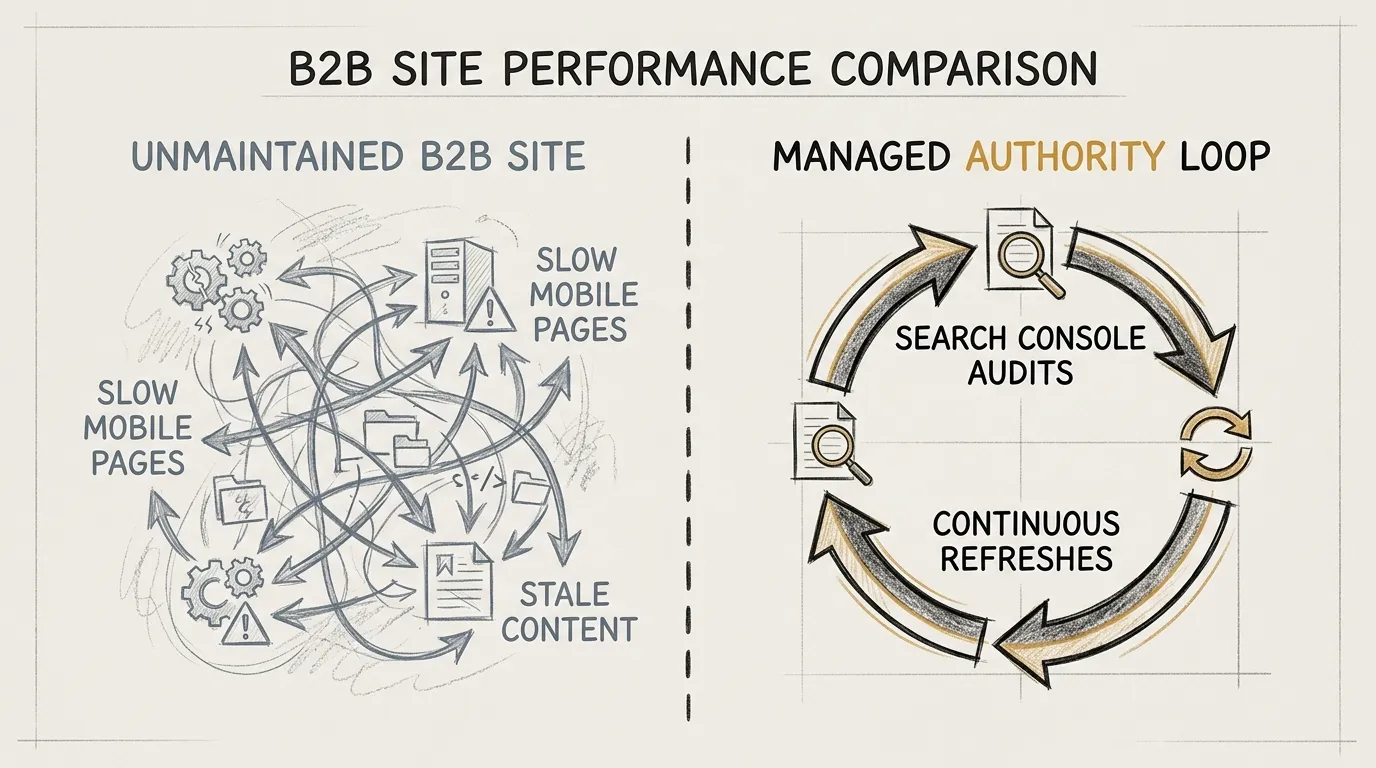
Skipping routine maintenance also creates an expensive surprise later. Companies often skip ongoing support to save a modest monthly fee, only to face emergency rebuilds when outdated dependencies break all at once.
Industry maintenance benchmarks show mid-market B2B sites typically budget $500 to $2,500 per month for ongoing upkeep, while skipping routine maintenance for three years often ends in $30,000 to $35,000 emergency rebuilds [2].
As we covered in why corporate B2B websites miss qualified leads, buyers form their shortlist before they ever speak to your sales team, so a broken or sluggish site costs deals you never even see.
Simple Intake handles the boring webmaster work so your operations team never has to chase freelance developers or debug broken forms.
Tired of worrying about broken forms, slow mobile pages, and expired security updates? Let Simple Intake run your company website infrastructure while your team focuses on operations.
Why Cookie-Cutter SEO Retainers Frustrate Operations Leaders
When non-tech leaders look for outside help, they usually run into two bad options: hire an expensive in-house developer, or sign an opaque agency retainer promising a fixed checklist of keywords. On r/b2bmarketing, founders regularly call out cookie-cutter proposals that sell "10 keywords and 4 generic blogs" without ever interviewing internal subject-matter experts or fixing underlying technical compliance [4].
Meanwhile, search behavior has shifted toward zero-click answers and AI summaries. Your site has to prove genuine operational expertise rather than publishing generic filler that any competitor can copy.
Research from Ahrefs shows AI Overviews appear on 18.9% of US keywords and can reduce traditional clicks by 34.5%, making proprietary customer research and niche depth essential to stay visible [3].
Chasing forced monthly backlink quotas or treating sitemaps as a magic trick will not solve that gap. Real discoverability comes from pairing clean technical plumbing with documented expertise from inside your own operation.
What Boring Webmaster Upkeep Actually Looks Like
A dependable B2B website does not need flashy 3D demos or constant redesigns. It needs clean, conversion-focused pages and a human team watching the unglamorous details every week:
- Speed and asset hygiene: Compressing images, splitting heavy scripts, configuring edge caching, and watching real-user Core Web Vitals instead of guessing from a single lab test [1].
- Technical SEO plumbing: Maintaining clean URL slugs, canonical tags, one clear H1 per page,
sitemap.xml,robots.txt, schema markup,og:imagepreviews, and checking for broken links or accidentalnoindextags. - Security and form protection: Enforcing HTTPS, keeping dependencies patched, blocking bot spam on contact forms, and configuring analytics and conversion pixels cleanly.
- Search Console feedback loops: Tracking which queries earn impressions, refreshing pages sitting in positions 5 to 20, and strengthening internal links across your managed website for service businesses.
Turning Raw Team Knowledge Into Compounding Authority
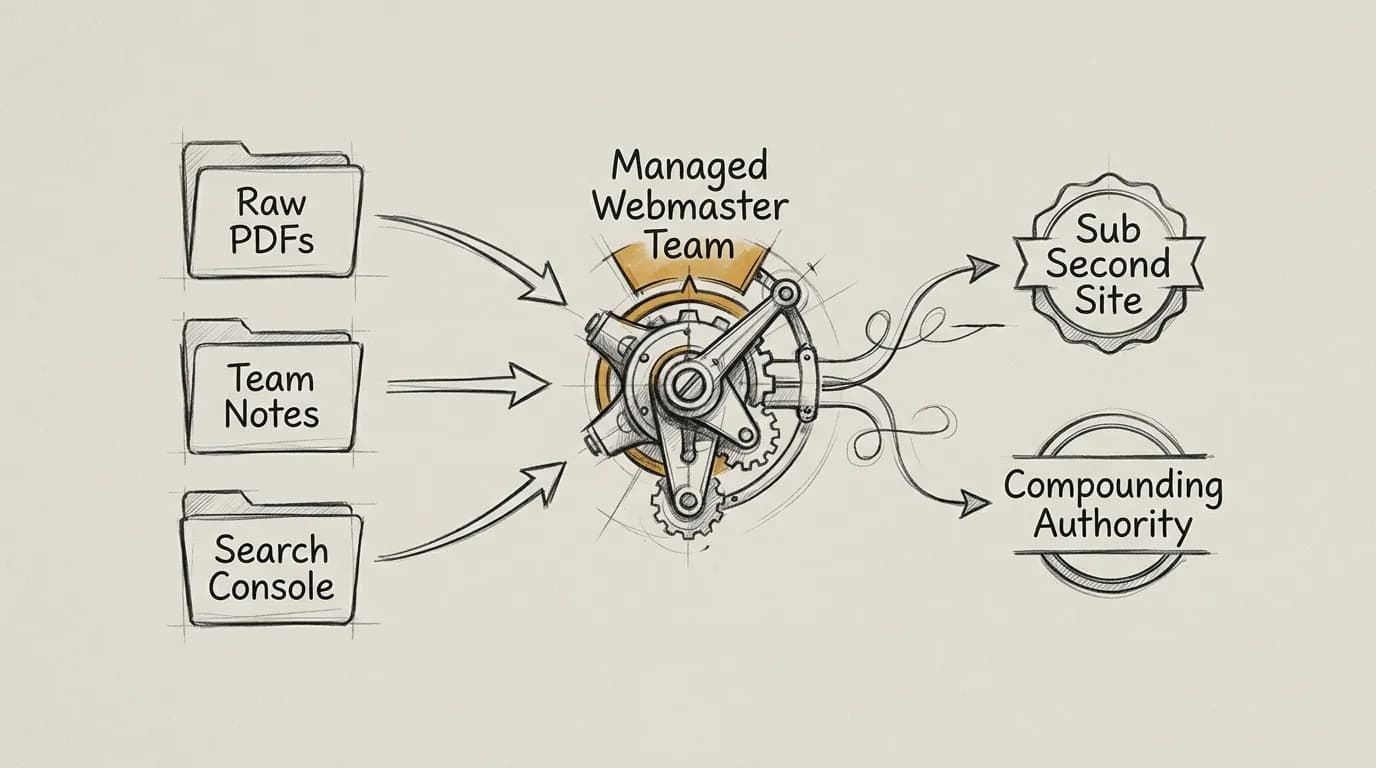
Most operations teams already sit on the exact material needed to win buyer trust. Your engineers answer technical questions every week, your account leads solve real client problems, and your team produces internal PDFs, checklists, and project photos.
Instead of asking busy managers to sit down and write polished articles every Friday, an outsourced knowledge workflow lets your team send raw notes, PDFs, or project updates asynchronously. AI helps organize and research around that raw material, while human editors review, verify, and publish clear guides and case studies that compound over months and years.
If your business serves multilingual regions, you can also layer in AI-assisted localization or human language review depending on your budget. And if your operations later require custom payment workflows, booking systems, or AI integrations, those can be engineered on demand without bloating your core site on day one.
Comparing how consulting websites price authority systems shows how predictable ongoing ownership replaces sporadic emergency rebuilds.
Want a sub-second corporate site that turns your team's real experience into lasting search authority? Explore how Simple Intake can keep your B2B site fast and continuously maintained.
Frequently Asked Questions
What does a managed B2B website service actually handle each month?
A managed webmaster partner handles hosting, security patching, form spam protection, Core Web Vitals tuning, Search Console monitoring, internal linking, and ongoing content updates. You own your domain and data while offloading the technical upkeep.
Do non-tech teams need to write blog articles themselves?
No. Your team simply shares raw notes, customer questions, project photos, or internal PDFs as they come up, and the editorial team turns that real expertise into researched, human-reviewed articles and refreshed service pages.
Should we expect a guaranteed number of leads every month?
No credible technical partner can promise a fixed lead count because demand, pricing, and sales follow-through belong to your business. What a partner should guarantee is fast, reliable infrastructure, clean technical SEO, and consistent authority work that compounds over time.
References
- Core Web Vitals Pass Rate: 49.1% of 13.75M Sites (PageSpeed Matters / Chrome UX Report)
- Website Maintenance Cost: What to Budget After Launch (Top Website Agencies)
- Welcome to Zero-Click Search. Please Leave Your Traffic at the Door. (Ahrefs)
- How do I evaluate SEO agencies? (r/b2bmarketing on Reddit)